

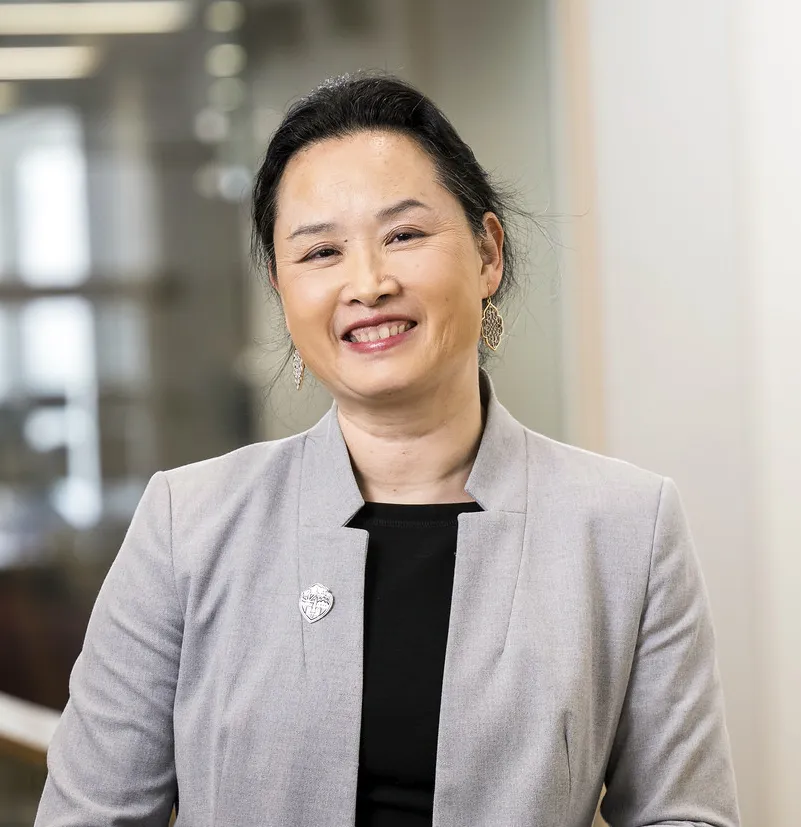
Endowed Chair and Director, Linus Pauling Institute
University Distinguished Professor, College of Health
Contact:
305 LPSC
541-737-9559
[email protected]
Emily Ho, Ph.D., is the Director of the Linus Pauling Institute and Professor in the College of Health at Oregon State University. She joined the nutrition faculty at Oregon State University in 2003. Prior to becoming director of the LPI, she was the Endowed Director of the Moore Family Center for Whole Grain Foods, Nutrition and Prevention in the College of Public Health and Human Sciences. As faculty and a leader at Oregon State University, she has a strong commitment to engaging and facilitating multi-directional translational research projects with basic scientists, clinicians, policy-makers, and communities, and involving experiential learning with students and postdoctoral researchers.
Research Interests
Dr. Ho's research focuses on understanding the mechanisms by which nutrient status and healthy foods affect the initiation and/or progression of chronic diseases, such as cancer. Her work has helped drive dietary requirements and recommendations for micronutrients such as zinc for communities with susceptibility to poor nutrition. She also has significant expertise in the study of food-based bioactives for health, including phytochemicals such as sulforaphane from cruciferous vegetables. An important strength to her approach in her research is maintaining a mechanistic focus on diet/environment interactions and encouraging to work in multi-disciplinary teams to facilitate the translation of cellular mechanistic studies to impact human populations.
Education
- B.S., Nutritional Sciences, University of Guelph
- Ph.D., Nutrition Sciences, The Ohio State University
- Postdoctoral Fellowship, University of California, Berkeley
Featured Publications
Beaver LM, Jamieson PE, Wong CP, Hosseinikia M, Stevens JF, Ho E. (2025) Promotion of healthy aging through the nexus of gut microbiota and dietary phytochemicals. Adv Nutr. 16(3):100376. doi: 10.1016/j.advnut.2025.100376.
Bouranis JA, Beaver LM, Wong CP, Choi J, Hamer S, Davis EW, Brown KS, Jiang D, Sharpton TJ, Stevens JF, Ho E. (2023) Sulforaphane and sulforaphane-nitrile metabolism in humans following broccoli sprout consumption: inter-individual variation, association with gut microbiome composition, and differential bioactivity. Mol Nutr Food Res. 68(4):e2300286. doi: 10.1002/mnfr.202300286.
Davis EW, Wong CP, Arnold HK, Kasschau K, Gaulke CA, Sharpton TJ, Ho E. (2022) Age and micronutrient effects on the microbiome in a mouse model of zinc depletion and supplementation. PLoS One. 17(12):e0275352. doi: 10.1371/journal.pone.0275352.
Ho E, Wong CP, King JC. (2021) Impact of zinc on DNA integrity and age-related inflammation. Free Radic Biol Med. 178:391-397. doi: 10.1016/j.freeradbiomed.2021.12.256.
Atwell LL, Zhang Z, Mori M, Farris P, Vetto JT, Naik AM, Oh KY, Thuillier P, Ho E. (2015) Sulforaphane bioavailability and chemopreventive activity in women scheduled for breast biopsy. Cancer Prev Res (Phila). 8(12):1184-1191. doi: 10.1158/1940-6207.CAPR-15-0119.