

The Linus Pauling Institute recommends that all adults take a daily multivitamin to help meet their nutritional needs. Finding the right multivitamin starts with understanding your choices.
Types of Formulas
Multivitamin formulas exist for different sexes and life stages: men, women, pregnancy, and older adults (50+) being the most common. Select a formula that is specific to your needs.
Formulas also exist to support certain aspects of health, like brain or bone health. While these multivitamins may be good choices, it is important to evaluate the supplement label.
Supplement Brands

Look for a supplement brand that bears a certification seal from an independent, third-party organization, such as USP or NSF. Such organizations test supplements to ensure quality and safety.
Note that this a voluntary testing, and not all companies participate due to the cost.
Supplement Forms
Multivitamins come in many forms, including tablets, powders, gummies, and liquids. There is currently no reason to choose one form over another if they contain the vitamins and minerals you need.
A good multivitamin doesn’t have to be expensive. Some high-quality multivitamins cost only a few cents per tablet.
For optimal health, supplements should complement a balanced diet, not replace healthy foods.
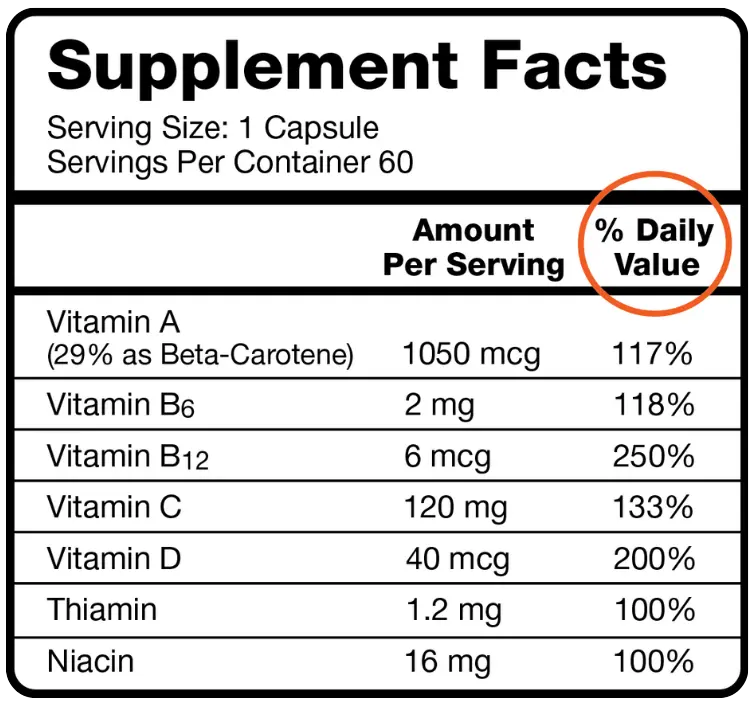
The Supplement Facts label lists the amounts of vitamins and minerals in one serving (listed as mg or mcg).
Look at the section labeled % Daily Value for perspective on the amounts.
- Choose a multivitamin that contains most vitamins and minerals at 50%-150% of the Daily Value.
- Avoid multivitamins that contain many nutrients in excess of 200% of the Daily Value, except for vitamin B12, vitamin C, and vitamin D, which are generally safe at higher amounts.
- Multivitamins don’t contain 100% of the Daily Value for certain minerals, such as calcium and magnesium. You might need an additional supplement of these minerals if your intake from food sources is inadequate.
- Women of childbearing age should take a multivitamin with iron. In general, men and postmenopausal women should take a multivitamin without iron.
Eat a Healthy Diet
For optimal health, supplements should complement a balanced diet, not replace healthy foods.
Drug-Nutrient Interactions
Always tell your healthcare provider if you are taking supplements. Supplements can interact with medications and affect the results of certain blood tests.
See the Drug-Nutrient Interaction Resource in the Micronutrient Information Center.
The Top 10 Project is a joint effort between the Linus Pauling Institute and the Oregon State University Extension Service. This project is supported by an unrestricted educational grant from Haleon, PLC and a grant from The Whatley Charitable Trust.